

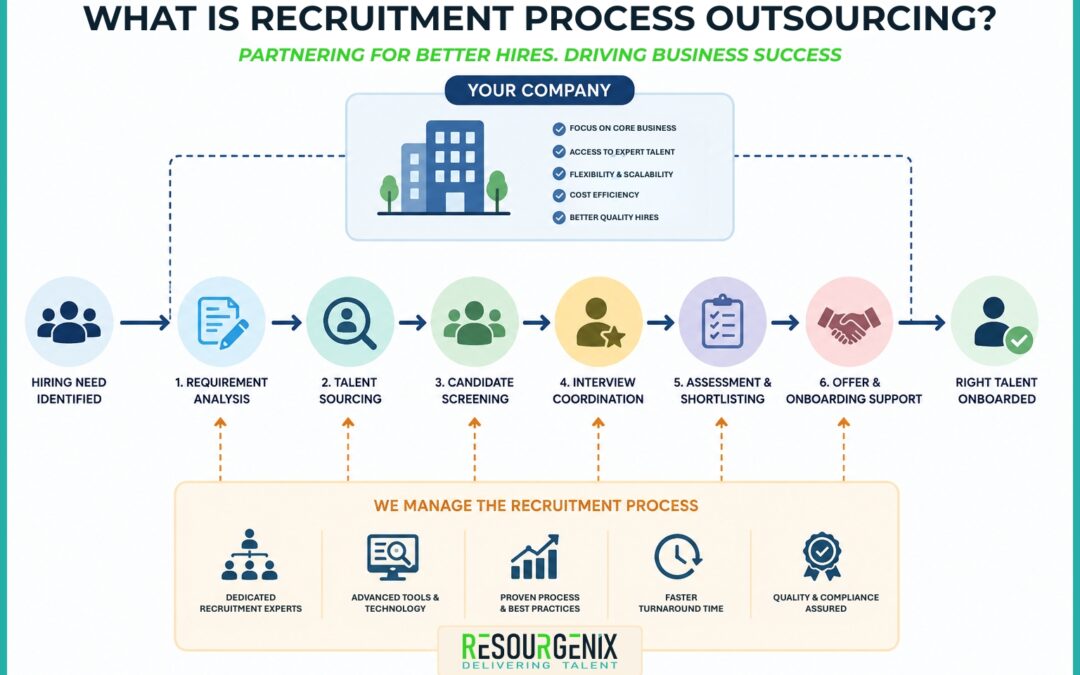
Recruitment Process Outsourcing, or RPO, is one of those terms that is widely used and often misunderstood. For some, it means handing recruitment over to an external provider. For others, it is seen as a way to reduce agency spend or speed up hiring. In reality, it is far more nuanced.
RPO is not simply a service you switch on when hiring becomes difficult. It is a different way of structuring how your organisation attracts and hires talent. Understanding when it works, and when it does not, is what makes the difference.
What is RPO
At its core, RPO is a partnership model where an external provider takes responsibility for part, or all, of your permanent hiring process. That responsibility can range from sourcing candidates for specific roles, to managing the entire recruitment lifecycle across the business.
This typically includes:
- Workforce planning and hiring strategy
- Employer branding and candidate attraction
- Sourcing and screening candidates
- Managing the interview process
- Offer management and onboarding
- Reporting and performance tracking
The key difference between RPO and traditional recruitment is not just who does the work. It is how the work is structured. RPO is embedded. It operates as an extension of your business, aligned to your processes, culture, and objectives. It is not transactional. It is designed to build capability.
What RPO is not
A lot of confusion around RPO comes from what it is assumed to be. It is not the same as using recruitment agencies on a contingency basis. It is not simply a cost-cutting exercise or a short-term fix for a sudden hiring spike, and it is not about removing control from your internal team. When RPO is approached as a quick solution to a short-term problem, it rarely delivers the expected results. The value sits in consistency, structure, and long-term alignment.
When RPO works
RPO tends to deliver the strongest results in environments where hiring is both important and complex. There are a few common scenarios where it becomes particularly effective.
When hiring demand is high or growing
Organisations that are scaling often find that internal recruitment teams cannot keep up with demand. Roles remain open for longer, agency reliance increases, and hiring becomes reactive. RPO introduces a more structured approach that can scale with the business. It allows hiring to move from reactive to planned, with dedicated resource aligned to demand.
When consistency is lacking
In many organisations, hiring processes vary significantly between departments or regions. Different stakeholders follow different approaches, which can lead to inconsistent candidate experience and uneven quality of hire. RPO brings standardisation. It creates a consistent framework for how roles are defined, candidates are assessed, and decisions are made.
When employer brand is not translating into hires
Some organisations have a strong brand in the market but still struggle to attract or convert the right talent. Others are less visible and find it difficult to compete for scarce skills. RPO places a stronger focus on how the organisation is positioned to candidates, and how that positioning is translated into effective sourcing and engagement strategies.
When visibility and data are limited
Hiring decisions are often made without clear insight into performance. Time to hire, cost per hire, source effectiveness, and quality of hire are not always tracked in a meaningful way. RPO introduces reporting and analytics that allow organisations to make more informed decisions and continuously improve their hiring approach.
When agency reliance is high
Many organisations reach a point where agency usage becomes the default rather than the exception. This can drive up costs and reduce control over the hiring process. RPO does not eliminate agencies entirely, but it creates a more controlled environment where they are used strategically rather than reactively.
Is RPO always the solution?
RPO is not a one-size-fits-all solution. It may not be the best approach if hiring volumes are low and stable, with minimal variation over time. It may also be less effective if the organisation is not ready to adopt a more structured, process-driven approach to hiring. RPO requires alignment. It works best when there is a willingness to standardise processes, adopt data-driven decision-making, and treat hiring as a strategic function rather than an administrative task. Without that alignment, the model can feel restrictive rather than enabling.
How does RPO fit into a broader workforce strategy
RPO focuses specifically on permanent hiring. It addresses how organisations build and scale their internal workforce. In many businesses, this is only one part of the broader talent picture.
Where contingent labour plays a significant role, RPO often sits alongside other models, such as Managed Service Provider (MSP), which focuses on contractor and supplier management.
Understanding where RPO fits within this broader context is important. It is not designed to solve every workforce challenge, but it plays a critical role in building long-term capability.
A more practical way to think about RPO
Rather than viewing RPO as an outsourced service, it is more useful to think of it as a way to redesign your hiring function. It shifts recruitment from being reactive and fragmented, to structured and aligned with business objectives. It introduces accountability, consistency, and scalability into a process that is often under pressure, and when it is implemented in the right context, it allows organisations to hire with greater confidence and control.
Final thought
RPO is often positioned as a solution to hiring challenges. In reality, it is a framework for how hiring is done. It works best when the organisation recognises that recruitment is not just about filling roles, but about building capability for the future. When that mindset is in place, RPO becomes far more than a service.
It becomes a strategic advantage.